Categories
Food Processing

Meat & Soup: At What Point of Cooking Should Salt Be Added?

Chefs all around the world have contradictory views as regards the timing of adding salt to foods during cooking. In fact, there is no record of any research that has shown and proven which time of salting is healthier or appropriate. Based on the controversies, I have decided to join the chain of food professionals to share my opinion in line with my training and experience as a food scientist.

adding salt to stew

Salting For Different Types of Food

I have also discovered that the process of salting actually differs for different foods but this time, my decision is only to write on these two meals (Meats and Soups) since they are regularly cooked in most house holds on daily basis. Before the emergence of refrigerator and other forms of preservation of foods, historically, the primary reason for adding of salt to food was for preservation. Flavour and taste was a secondary purpose. Lets see the appropriate timing to add salt to the two meals.

When, During Cooking Should You Add Salt To Meat?

I do not know if it is because we want to get things done quickly or it is the better way; what I see mostly is people adding salt to meat from the very start in addition to other additives like onions, MSG and other. When this is done, it tends to harden the meat. The addition of salt raises the boiling temperature thereby reducing the cooking time but less natural meat flavour is released as salting closes the pores of the meat.

Hey friends, I am particularly interested in the flavour of the meats when I am cooking. For me, I have adopted adding salt to my meats almost at the end of cooking. It provides an opportunity for the natural flavours of the meat to be produced. It also helps in reducing the amount of salt to be added which is healthier for high blood pressure patients.

ALSO SEE: Effect of too much salt on the body!

Salting of Soups and Stews:

The idea of adding salt at the start of cooking soups is fairly common among students but gradually creeping into the method of cooking by many house wives. In fact, it was in the University that I first notice this. Students are always in a rush. When you add salt at the start, as the soup thickens, only water is evaporated not salt, so you might likely end up with a slightly salty food as you would have added salt based on the initial volume of the soup.

It would be smarter to add salt much later into the cooking when the soup is almost at your desired thickness. That way, you will avoid salty food. Remember the daily requirement of sodium should not exceed 2300mg per day which is an equivalent of about 10grams of salt. To much salting due to adding at the start of cooking could raise your daily sodium level above 5000mg which is unacceptable.

ALSO SEE: How much salt is too much to consume per day?

I do believe some of you have contrary opinions and methods you have adopted for many years that have made your food a delight to your family. Please share with us if you agree or disagree with this write up.
Categories
Food Recipes

Learn How To Make Oha Soup (Recipe)

I am a lover of soups and everyone around me knows that. Each time I visit a new environment, all I ask about on entering any of their restaurants is the different types of soups available and I opt for those I have not eaten before. Sometimes I get disappointed but most times I am elated especially when I am in the eastern part of Nigeria.

I have to give the credit of this article to a friend Miss Patience Chieme who was willing to share with me the recipe for this soup. When I tasted the soup the very first time, I knew only few Nigerian soups can compete with this in terms of taste, colour and expected nutritional value. It will also interest you to know that the leaves of Oha do not lose their nutritional and photochemical properties easily during preparation. Let’s look straight into how this delicious soup can be made.

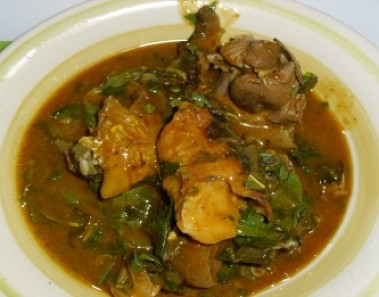
oha soup

What are the ingredients to make Oha soup?

  • Beef (700g), stock fish (500g), blackfish (300g) and grained crayfish (As appropriate). Remember, you can increase the quantity of protein source to be used based on your family’s size)
  • Water, Palm oil ( Add as appropriate)
  • Black Pepper and onions ( Add as you would prefer)
  • Cocoyam (6 small corms) or Achi and Oha leaves
  • Seasonings and Salt

Pre-cooking Direction

  • Ensure you wash your hands properly to avoid external contamination.
  • Grind onions with a hand grater and set aside.
  • Also grind crayfish and black pepper together and set aside.
  • Wash and boil the cocoyam corms until it is completely soft and remove the peels and use a mortar and pestle to pound the corms to a smooth paste. Some people have also used blender to achieve similar result.
  • If cocoyam is not available. Achi can be used. It is commonly sold among Ibo foods sellers. It will also act as thickener. Few table spoons will be dissolved in little water to form a paste. This can be done at that point when it is to be added
  • Use your fingers to pick the Oha leaves, wash them properly and cut the (Oha) leaves into tiny pieces using your hands and keep aside. Although, there is report that if you use knife to dice the leaves, the soup will turn bitter but a friend of mine who tried both methods did not notice any significant difference talk less of bitter taste. But hey, to stand on the safe side, use your hands…..it is quite easy.

NOTE: DO NOT FORGET TO PROPERLY WASH ALL THE INGREDIENTS BEFORE COOKING.

Now Let’s Check How The Soup Is Prepared

  • Put water in a pot and place on cooker.
  • Add meat and blended onion. Allow to cook until almost tender.
  • Add your stock fish, black fish, (and any other protein you wish to have in the soup).
  • Allow to cook to your own taste of tenderness.
  • When it has cooked properly add Palm oil allow to cook up to 3 minutes.
  • Add your blended crayfish, black paper, and allow to cook up before adding salt to taste. Cook for another few minutes.
  • Add the blended/ pounded cocoyam paste or Achi that had been dissolved in ordinary water to thicken the soup. Ensure you stir to avoid sticking to the pot. Cook for few minutes.
  • Add cube seasonings to taste plus Ogiri (optional but it adds a lot traditional flavour to the soup).
  • When it has properly cooked, add your Oha leaf (Remember, the Oha leaf is chopped with hands not knife) and after 1 or 2 minutes your Oha soup is ready. Ensure the leaf retains its greenness.
  • Serve with any solid food (Wheat, Semolina, Pounded yam, Eba, and Fufu).

Oha soup is native to the eastern part of Nigeria. Just give this recipe a try and you are on your way to making the delicious soup and you will love it. Do not forget to share if you tried it or share your own way of making Oha Soup.

#ILOVENAIJAFOODS

Categories
Food Recipes

How To Make Afang Soup The Akwa Ibom Way (Recipe)

On the 8th of March 2011, clarion call took me to Akwa Ibom shortly after I graduated from the University. As soon as I received my posting letter and I saw Akwa ibom, I knew I was in for food adventure. Indeed, my expectation was met during my one year compulsory sojourn. This is how my romance with the soup started; now I can talk and even give people Afang Soup recipe as I picked it from Akwa Ibom.

The night I arrived the beautiful city of Uyo the capital of Akwa Ibom, I was completely exhausted and hungry….So, I had to visit the restaurant. My first meal was Afang soup plus Garri (Eba). I had not tasted the soup before and I decided to give it a shot since it had always being talked about as a super soup by many who have been opportune to have a bite. As it was served, not only did the soup look so attractive, it also smelled great. With enthusiasm, I took the first bolus of Eba with the soup. It took me by surprise. Delicious was an understatement.

Photo Credit: avartsycooking.comAs a young man who had lived his entire life majorly in Yorubaland, none of their soups taste this great. As stay with the indigenes during my service year, I did learn the nitty-gritty of how the soup is prepared to taste the Akwa Ibom way. Follow the recipe and all included below and your highly nutritious Afang soup is ready.

Ingredients For Cooking Afang Soup

  • About 1kg of goat meat, 0.5kg of Stock Fish and 2 big African snails (Optional)
  • Half tin cup of Cray fish, Seasoning cubes, preferably Knorr (To make it tasty)
  • Pepper, Yellow pepper and Salt
  • Small amount of beef (optional), dry fish, 250g of kpomo (Cow skin), Onions (1-2 bulbs depending on size) and periwinkle.
  • Water as needed.
  • Finally, Water leaves and Afang leaves as appropriate.

Pre-cooking Steps Involved In Cooking Afang Soup

Step 1: Wash properly the goat meat, beef, kpomo, snail (with lime or potash), stock fish ( in salty hot water for few minutes). Keep the goat meat, beef, kpomo and snail meat in a cooking pot after they had been washed properly.

Step 2: Wash, drain and slice the Water leaves and Afang leaves. The sliced Afang leafs has to be grinded.

Step 3: In a separate bowl, wash and dice onions and some pepper.

Important Note: Do not forget to properly wash your hands before handling the food items.

How To Prepare The Popular Afang Soup

The following steps will guide you in preparing the Afang soup the way people of Akwa Ibom state prepare it.

  • Place the washed meats in step 1 above on low heat and cook until the meats are tender. Do not forget to add adequate amount of water, diced onions, pepper and salt. After the meats are tender, add the washed stock fish and cook for about a minutes or two. Ensure you have enough stock water.
  • Add palm oil and allow to boil for two minutes.
  • Add the diced water leaves and allow to cook for about 3 minutes
  • Add other ingredients like Maggi (seasoning), crayfish and periwinkle and allow to boil before adding the Afang leaves. Taste the soup to know if there is need to add more salts. Allow to cook for about 3 minutes. Ensure the leaves still possess the greenness.

Your Afang soup is ready to be served.

Afang soup has medicinal purposes for sore throats, nausea and loss of appetite It is a rich source of vitamins with loaded essential and non- essential amino acids. It also has anti- inflammatory and anti-oxidant properties. Go ahead and go give it a try.